
Hope Is Not The Absence Of Grief
What Walden at Icarus Theatre has taught me about facing the uncertainty of our future.
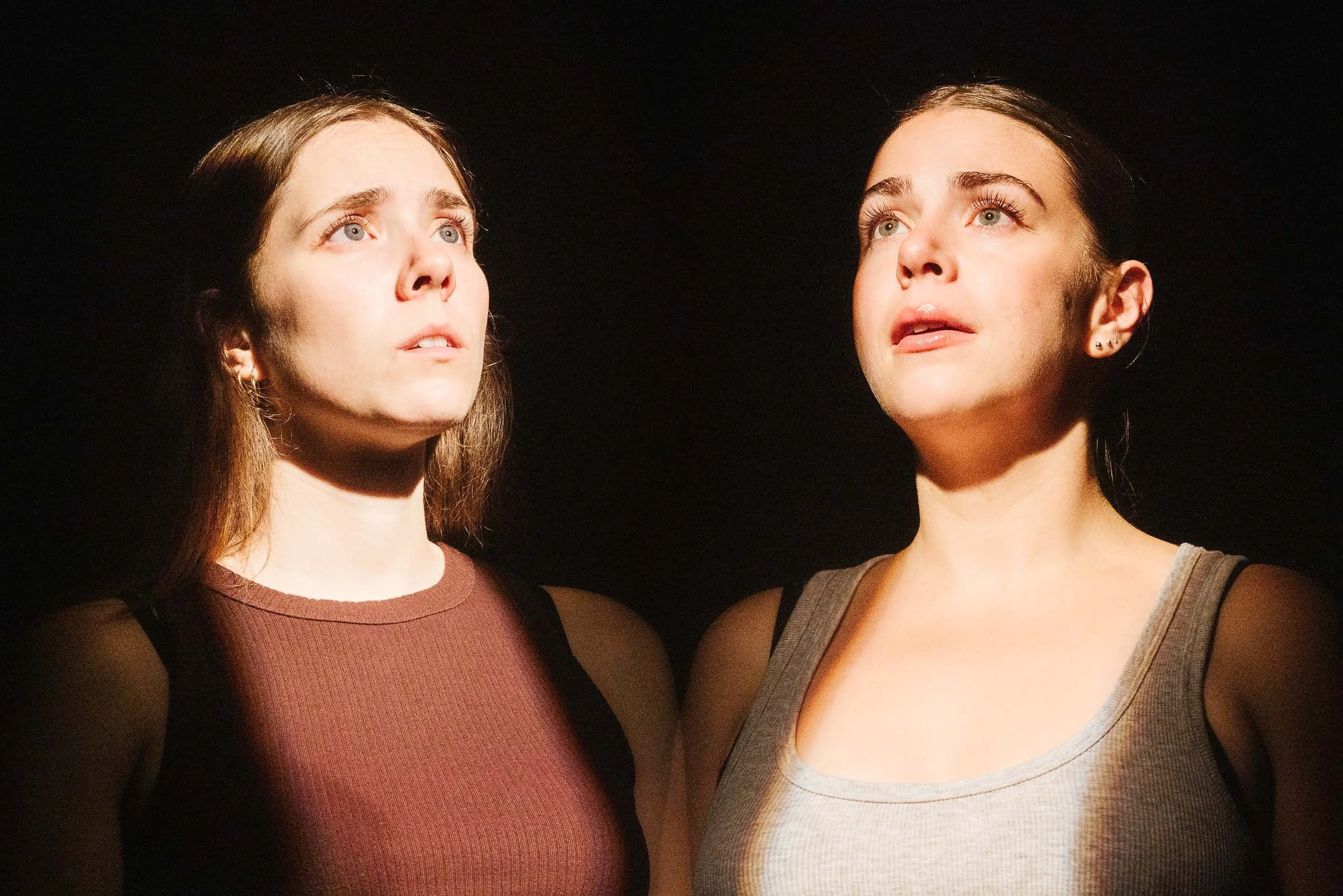
Left: Emily Anne Corcoran as Stella
Right: Charlotte Dennis as Cassie
Photo credits: Sandro Pehar
I have no problem admitting that I have reached a level of disillusionment about the state of the world that has left me angry on a good day, and numb beyond belief on most others.
It didn’t take long to get to this point. Every day for years, my social media feeds have been flooded with images and videos of children being murdered in Gaza, ICE separating families and killing those who stand up for them, books I read in high school being banned, women being stripped of their bodily autonomy, and more far-right politicians garnering popularity while forest fires and flash floods and heat waves and mud slides kill thousands across the world. And this is barely touching the surface of what we are witnessing.
The world is in shambles, and it has been for quite some time. And those of us who, for now, have won the geographical lottery and are lucky enough to just be witnessing most of these things, continue on with our days as if nothing is happening. Things are getting worse, and most of us turn a blind eye. For the rest of us who try to bear witness, we are left wondering how we can help while also facing the terrifying reality that the futures we imagined for ourselves might not exist. When that luck wears off, what kind of future will be waiting for us? What can we do until then?
These sorts of questions were very much at the forefront of my mind before and after I attended the Canadian premiere of Walden presented by Icarus Theatre and directed by Erik Richards at the Theatre Centre in Toronto on September 12th.
The play written by Amy Berryman is set in a not-so-distant future where NASA botanist Cassie (Charlotte Dennis) returns to Earth after a year-long moon mission. She reunites with her twin sister, former NASA architect Stella (Emily Anne Corcoran) who now lives with her fiancé, Bryan (Oshen Aoun) on an environmental reserve that is unravaged by the escalating climate crisis around them. Walden follows the two sisters and Bryan as they navigate the complex emotions of the reunion, especially those that arise from their on-going conversations about choosing to stay on Earth vs. space colonization to save humanity as climate conditions continue to deteriorate.
I had the pleasure of speaking with Charlotte and Emily the day after the premiere, where I got to understand more about how they were feeling, the emotional journeys of their characters and their relationship with each other, and how Emily’s choices as costume and prop designer factored into this story that hits way too close to home.
I felt compelled to direct my first question towards Charlotte, a first-time collaborator with Icarus Theatre.
What drew you to the story? What made you want to sign on once you found out about it?
C: “I'm going to be honest, it was the people that drew me to working with the team. Not that the script came secondary, but I was so keen. I have known these guys for a couple of years, and to work with Erik and Em particularly, I was sold immediately. And then in terms of the actual script, I feel like it is a conversation that I'm having with a lot of the women particularly in my life. This idea of getting older in this environment, in this climate crisis, in this political crisis, and what it means to feel autonomous in our decisions as women. Do we want to have kids? Do we not want to? What does that mean? And this kind of grief that can come with the reimagining of what we thought our lives were going to look like.”
Emily, an artistic associate at Icarus Theatre, helped bring this story to life in Canada. Founded in 2022, the independent theatre company based in Toronto states on their website that they spotlight “pieces that offer unique perspectives on modern issues - pieces that make you argue in the lobby.” It’s no surprise that Walden fits right in.
When you read the script the first time, what were your thoughts? How did you feel?
E: “I was on a string of reading a few plays that I felt like I was just really frustrated with. I thought they were sexist or outdated in their values, and I was just so uninterested in everything I was reading. And Walden was the next in my list, and so I pulled it up. And in a pretty bad faith way, I was like, ugh, I have to read one more play today. And then I got maybe 10, 15 pages into the play, and I paused what I was doing. I texted Anthony and Erik, and I was like, I found it. And so we went from there. I love that it's so timely in the way it talks about the climate crisis, but it takes these huge issues and scales them down to the minuscule and has it really be a story about family, about love. And I think the questions it's asking, of what's our responsibility to ourselves, to the world, and to the people around us, was really striking. And, yeah, it just made it right away something that I wanted to dig into.”
They did jump into things very quickly; it’s admirable how seamlessly the women appear to have stepped into their roles considering the very short rehearsal process, as confirmed by Emily. Charlotte emphasized they only entered the theatre space on day eight or nine, which makes their performances even more impressive.
It was in this same part of the conversation that Charlotte also admitted she wasn’t initially sure if she could really understand Cassie, since she had in mind she’d be playing Stella. This becomes clearer as Charlotte explains:
C: “What I think was really interesting in the discovery was this militant aspect of what NASA has become in this not-so-distant future idea of the world [...]. Being raised in that environment, what does that mean for how they touch each other [...] how they show empathy for each other? That kind of thing that comes quite naturally, I think, to Emily and I is to be very touchy, very open, very vulnerable. And for these women, it's not.”
A lack of physical affection is what I expected as Stella awaited Cassie’s arrival at her and Bryan’s cabin. Her stress levels and guarded disposition in the opening scene with Bryan convinced me that would be the case, only to be met with the girls warmly embracing the moment they reunite. This was followed up by scenes later on containing shoulder and arm grabbing in heavy emotional moments, faces being caressed, and hugs being held on to for as long as possible, especially on Cassie’s part. The sisters were a lot more affectionate with one another than I anticipated, an observation I ran by Charlotte and Emily for confirmation further along in our conversation:
Is that something that was brought in intentionally?
C: “...We spent a couple of days operating under this idea that Cassie actually cannot be physically intimate at all [...] and we kept going over it. And cerebrally, it makes sense because of this military aspect, because she'd been on the moon with a small portion of people for a year. But there was something in the playing of it that just wasn't right. And I think what made more sense to me was this: physical touch is hard, but she is so desperate for it because she hasn't received it. So while it may be hard, the overriding experience is the need. And Stella is her person, you know? They are in utero together. We kind of landed in this spot that felt a little bit more natural to me, Charlotte, but also I think made more holistic sense in terms of the story.”
E: “They're extensions of each other. And I do think the military thing - it makes sense. On paper it works, and in reading the script it works. But in practice, I think both of these women are so unmoored and off the top of the show, they're shielding a great amount, but they really both do need a grounding force. And to put it simply, someone to grip onto. And they've always been that person for each other. And so I think that even though it's an awkward time [...], they both have this tie to each other that is inseparable.”
The reunion is indeed laced with an undeniable awkwardness at the start. As time goes on, their dynamic is sprinkled with moments of affection and nostalgia. However, things quickly turn tense when Cassie questions Stella’s new life and the trio disagree on whether it’s best to stick it out with Mother Nature or abort ship to Mars and start fresh.
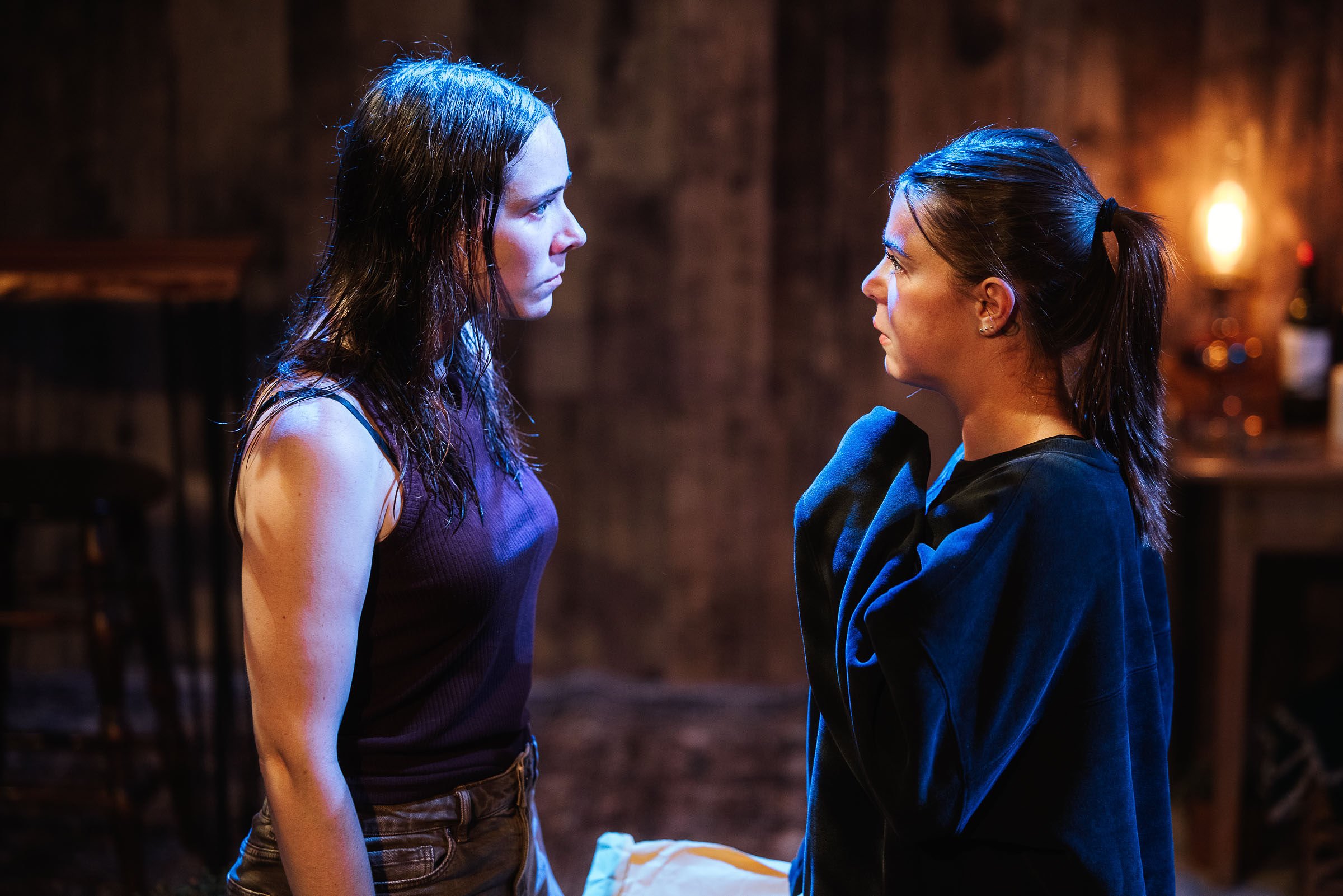
Left: Emily Anne Corcoran as Stella
Right: Charlotte Dennis as Cassie
Photo credits: Sandro Pehar
Cassie very much endorses space colonization. In her eyes, Earth has reached a no return point and their best shot is to begin anew elsewhere. A significant point of tension between the sisters stems from Cassie finding what seems to be a whole new person in her sister upon arrival. Stella finds merit in the off-the-grid, eco-friendly lifestyle she has adopted with Bryan, who is a staunch advocate for preserving the planet. This confuses and frustrates Cassie, who has only known Stella as the space-loving, anti-marriage woman she has always admired. However, it’s not lost on the audience, or Cassie, that Stella still supports space exploration; she can’t help but light up when Cassie informs her that NASA will use the habitat Stella designed, Walden, to colonize Mars.
Cassie reveals shortly after that she’s been selected to head this mission to Mars and asks her sister to return to NASA to assist, only for Stella to turn upset and refuse. This is when we learn that Stella left NASA only because she failed the physical tests that would have allowed her to become an astronaut. She’s now forced to reckon with not only seeing her sister live her dream, but the grief over her body “failing” her and the death of her dream because of it. Yet Cassie is hesitant. She feels that it’s an obligation more than a passion to go to Mars. She’s also afraid; she doesn’t want to be separated from Stella or a life on Earth that would be less isolating.
It becomes clear from this that the biggest source of tension gnawing at the sisters’ relationship is that each desires what the other has. Stella would drop everything to go to space, and Cassie is starving for connection.
The unique emotional worlds of the sisters unearthed by their reunion and the Mars revelation are brilliantly reflected in the costume and colour choices speared by Emily. I made sure to direct our discussion to understand the decision-making behind this:
I noticed with Stella's character that she was wearing Red a lot, or just a darker-coloured shirt. But I also noticed with Cassie, her outfits went from NASA & space-oriented to basically athleisure. Do you feel like that almost humanized her a bit more? Did you feel that with those costume changes?
C: “[Emily] is a brilliant designer, a very collaborative designer. She wants everybody to feel very, very comfortable and confident about how they look and are perceived on stage. And also she has a very clear story arc to everyone's clothing. [Cassie] enters the play having just landed. It feels almost like a uniform that she's got into. And then as she gets more comfortable in these scenes [...], as her body gets more comfortable with being around people, there is more comfortable clothing to go with that [...]. Like, to be in just a tank top and practically bare-faced and tight-bound, there's just something very vulnerable about that. And the colours that are used for Cassie are cool. They lean technology. They lean into this sort of different landscape than the other two. And it really is, like, Emily's brainchild, heartchild.”
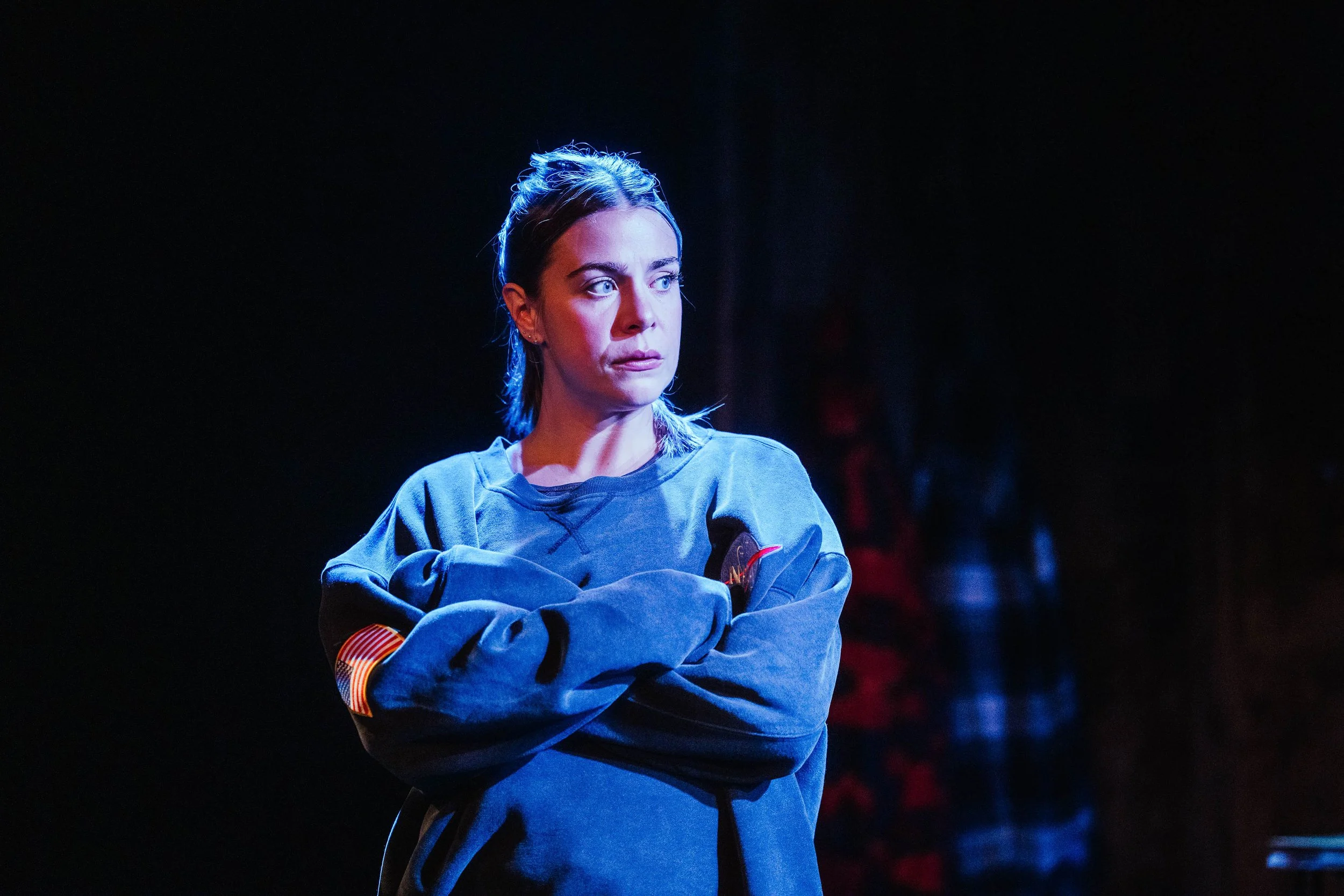
Charlotte Dennis as Cassie. Photo credits: Sandro Pehar
E: “Yeah. I love designing and I think that these characters just sing on the page. And to me, it was really clear what costume story we wanted to tell with each of them. Charlotte's dead on with everything we're talking about for Cassie. We did want to keep her in cooler, more neutral colours and then let her get into something a little more comfortable through the course of the play to ultimately be put back into something really vulnerable. For Stella, we wanted to bridge the gap a little bit between the two worlds. And so her clothing is a bit more structured than Brian's is, but it's not as structured as Cassie's. She does have a lot more reds and deep green and darker brown colours because I wanted her to have an earthy flair, but still something a little protected, which was very fun to find and to work with.”
The sisters unmistakably display a very complex relationship - one intertwined with love, resentment, jealousy, grief, and longing - that made me want to know more about how Charlotte and Emily navigated such a dynamic:
Did you pull from your own relationships with your siblings for this, or did you just kind of work together to develop this kind of relationship and try to learn from each other's characters as you navigated that?
E: “You know, it's funny. Neither of us have sisters. But in terms of finding what that dynamic was, I have girlfriends who I think of as my sisters. And Charlotte is someone who I think of as a kindred spirit. And so I think building that relationship came really easily and felt really true.”
C: “Yeah. I would agree. I think of Em as a very, very special, sacred person in my life, and it's been so special to explore this. What I will say is, you know, I think in the arts industry, we've been sort of primed to believe that our friends - and most of my friends are actors or artists in some capacity - that there can only be one and that we're in competition with each other. And it's taken a lot of effort and a lot of brave and deep and challenging conversations with my girlfriends to get that messaging out of our brains. And so I think this idea of being in competition feels familiar in a pretty painful way. And I'm grateful that in my life, those conversations don't exist anymore. But it's because we had to do the work. And I wonder if the sisters had been able to talk like my friends and I were able to talk, maybe they would have come to a different understanding.”
In the end, the trio’s bubble of protection on the reserve is severed with a devastating forest fire. Cassie ultimately decides to go to Mars, and Stella chooses to stay on the reserve with Bryan and have a baby.
I don’t think we are supposed to know whether they fully come to terms with the decisions they’ve made - they probably never will. And they might have come to different conclusions based on their unique circumstances, but after speaking with Charlotte and Emily, I’ve understood that the one thing that binds their choices together is that they are both rooted in HOPE. The consequences of that hope though, is grief. Grief in having to choose and give up what they truly want, voluntarily or not, to see that hope through. And not knowing if it’ll actually make a difference, yet trying anyway.
At first, I viewed Cassie as harbouring a hopelessness towards saving the Earth. I so greatly appreciated Charlotte and Emily challenging my understanding:
C: “I think that both of these women actually have profound hope, and that is the thing that tethers them. It's not hopelessness. It is hope. For Cassie, the hope is that we can create a better world somewhere else because this one is actually - and quite factually, as we see at the end of the play - it is the end of days. I think the core of what these two women believe is actually hopeful. And that's why they make the decisions that they do. I think what is hard is that the grief is so profound. This loss of planet, but also this loss of each other. Their family. They are each other's only people. So the reason Cassie is struggling so deeply with this decision to go, I don't think is because she doesn't believe in the idea, but it is because she is doing it alone and that there is no guarantee, if that makes sense. Does that resonate to you, Em?”
E: “Yeah, absolutely. And they're both grieving a life that they thought they were going to have. And in that, they're learning how to find hope in a new vision for the world and themselves and their lives. So, yeah, I think it is beautifully hopeful, but I think it's sticky because they're trying to figure it out and they're trying to learn if they're okay with it.”
Did you resonate with that fear of, I don't know what's going to happen, we don't have a solution? What is the solution?
E: “Totally. I think it's something that has remained really present through every part of the process. The first time I read the script, I was overwhelmed with that feeling. It’s one of the few scripts that I sat down and wept multiple times just reading it, let alone, you know, hearing it or whatever. It's come and gone throughout the whole process. What reading the script, when we put it up on its feet, and when we staged the transition where the fire started to take over. I think it's part of what's so strong about the script. It's - it's so close.”
C: “It is so close. I do just want to really give Erik his flowers in that he came to us and said, this isn't a play about the macro, about what this means globally. This is a play about the micro, which can allow us to actually feel what the macro is. It is a play about grief. It is a play about family. It is a play about loss and hope and love. The core of it is love. And so being able to kind of dig into the micro, the minutiae, the familial pain and love, I think, actually allowed us to be able to sit with what this means on a kind of global scale in a much more profound and deep way.”
This was just the first performance, so I wanted to gauge how both women were feeling going into the next two weeks of shows:
Reflecting on last night and just looking ahead for the next two weeks, what are you most looking forward to?
E: “You know, I'm just so excited by the conversations that have been happening after the previews and after opening. It’s a big story and you can sometimes get lost in it. What's been really beautiful is seeing how simple it really is and what people are taking away from it. I've had some really interesting conversations about the climate crisis and about what our responsibility is to each other and to the planet. And I look forward to hearing other people's thoughts on it as we continue to grow the show.”
C: “Yeah. I think very similarly there. It was so amazing to hear [...] the conversations they [my friends] were having surrounding what our responsibility is and both the fear and hope and reality of what's happening in the world, you know, environmentally, politically, socioeconomically, and our responsibility. And that we're kind of in it together. I just want to also give him [Oshen] his flowers. He's an incredible artist. And he's been so generous with both of us. And it's been such a gift to get to know him and to work with him. So I'm glad that our little trio gets to kind of go on stage tonight and play again. It'll be so fun. And I really hope that the play feels as impactful to watch as it has for us to work on.”
So maybe we don’t have to have the answers this very second. That might be the whole point. I think we just need to start having conversations, and tough ones, sooner rather than later. Because in a world that has become increasingly divided, sharing our fears and insecurities with those closest to us - but also not being afraid to have those conversations with strangers - and doing the work to change the messaging we’ve been given to compete with one another might be the first step in finding solidarity with each other. And only then might this spark encouragement to seek out ways to tackle our climate and political crises together.
I still remain disillusioned, but Walden allowed me to reflect on what we owe to each other and to the world we inhabit. The things going on around us are big, but progress has to start small. We can start by loving those around us fiercely and choosing to have hope but allow ourselves to grieve at the same time. And then, we just have to make sure we figure out what we can do to ACT, be disciplined, and hold ourselves accountable along the way, because we are all on the same team. And we’ve been taught to forget that. It’s time to address this. I know that I will be starting by challenging my own and friend’s thoughts and comments in conversations, and maybe those of you reading this will be encouraged to do this, too.
I’ll put faith in not hope itself, but how those of us who refuse to stand back use that hope (and grief) to guide us forward, no matter how bleak the future looks from where we currently stand.