
A different kind of freedom
Sara Porter’s new multi-disciplinary performance, Hello Sunshine! speaks to the everyday absurdism, hidden challenges, and unexpected beauties of living life with an invisible disability.
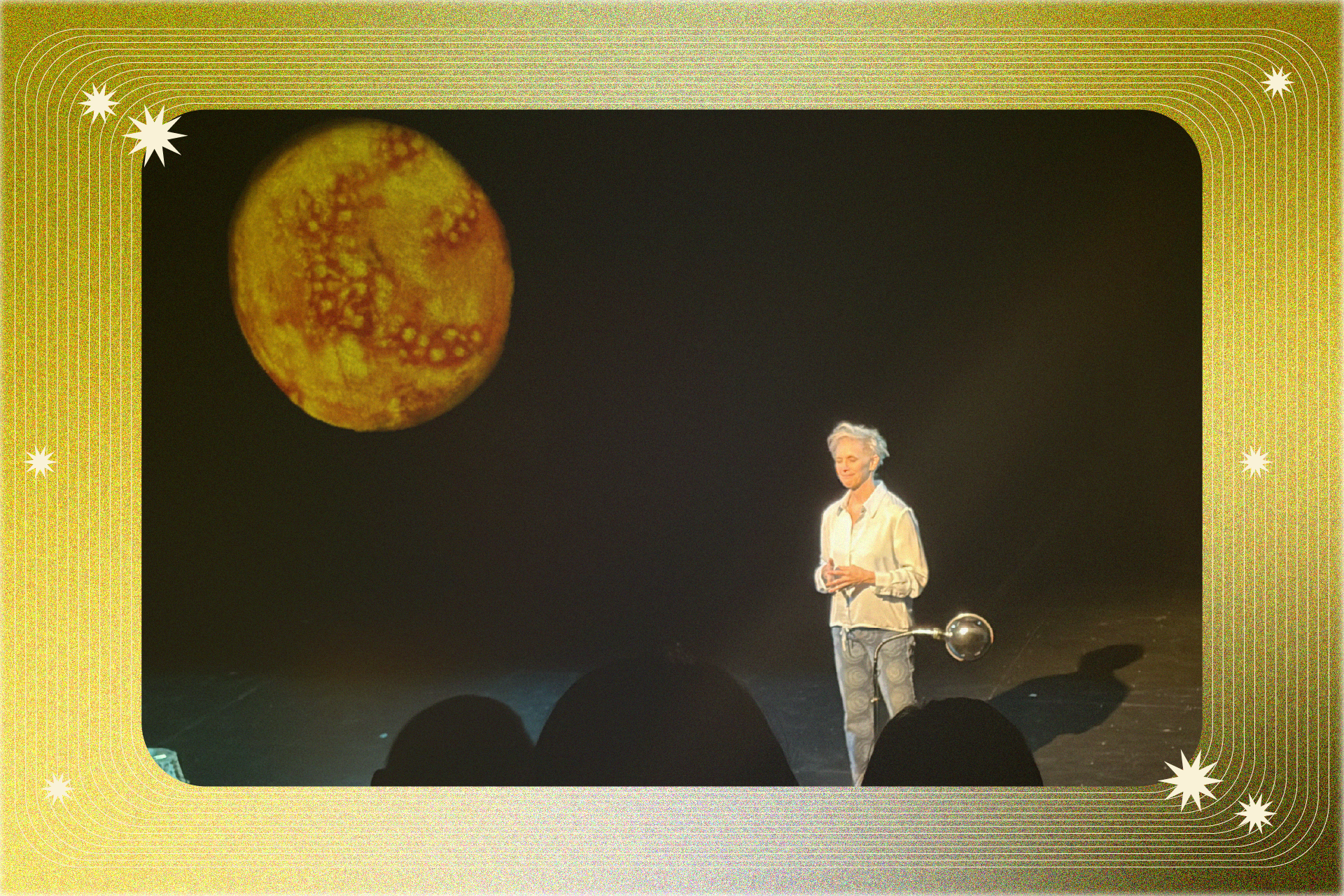
Sara Porter’s Hello Sunshine! makes its world premier at the Franco Boni Theatre Centre, located in the city’s west-end, as a part of the 2026 SummerWorks Performance Festival. The quaint and intimate theatre space makes the audiences feel close to the intensity of Porter’s opening performance.
The room was dark and the air was filled with the buzzing hum of anticipation as I sat down to watch dancer and choreographer Sara Porter’s latest multidisciplinary performance, Hello Sunshine! I came into the performance with little to no expectations, and limited knowledge of how dance performances worked, or who Sara Porter is.
But scene by scene, song by song, and each unexpected moment of rawness and hilarity later, I walked away from my first ever dance performance with an incredibly unique mix of emotions and reflections that I believe only an artist and performer like Porter, who manages to reach within all the difficult-to-understand, beautiful, chaotic, and tender corners of her life, can invoke.
When Porter was 23, she suddenly found herself unable to tolerate sunshine. At 27, Porter found out she had Polymorphous Light Eruption (PMLE), an autoimmune condition where the skin is unable to absorb normal amounts of UV light. As an idiopathic and polymorphous condition—meaning the condition’s root cause is unknown and manifests uniquely in each person, respectively—PMLE, something Porter calls her “sun thing,” often causes rashes, bumps, and blisters on exposed body parts and, as in Porter’s case, becomes more severe with age. To describe it more completely, Porter was unable to walk, talk, or freely move sometimes.
It’s a unique contradiction. In a world where so much of our imaginaries of fun, exploration, movement, and just spending time with ourselves and the planet involves being outside and frolicking in or soaking up the sun, there’s no rulebook that exists to help those who are—colloquially speaking—allergic to the sun, navigate life. What happens when the very notion inhabiting our bodies with freedom becomes transformed into an everyday medical, logistical, social, and emotional hurdle that often exists beyond mere language and the exhaustion of explanation?
Through an elegant, strikingly original, and tenderly funny blend of creative social commentary and personal experiences stitched together with songs, dances, and energetic monologues, Hello Sunshine! invites audiences to bear witness to a world where the everydayness of life—a social outing with friends, a visit to the doctor’s office, or a family beach day—are transformed under the pressures of living with an invisible disability.
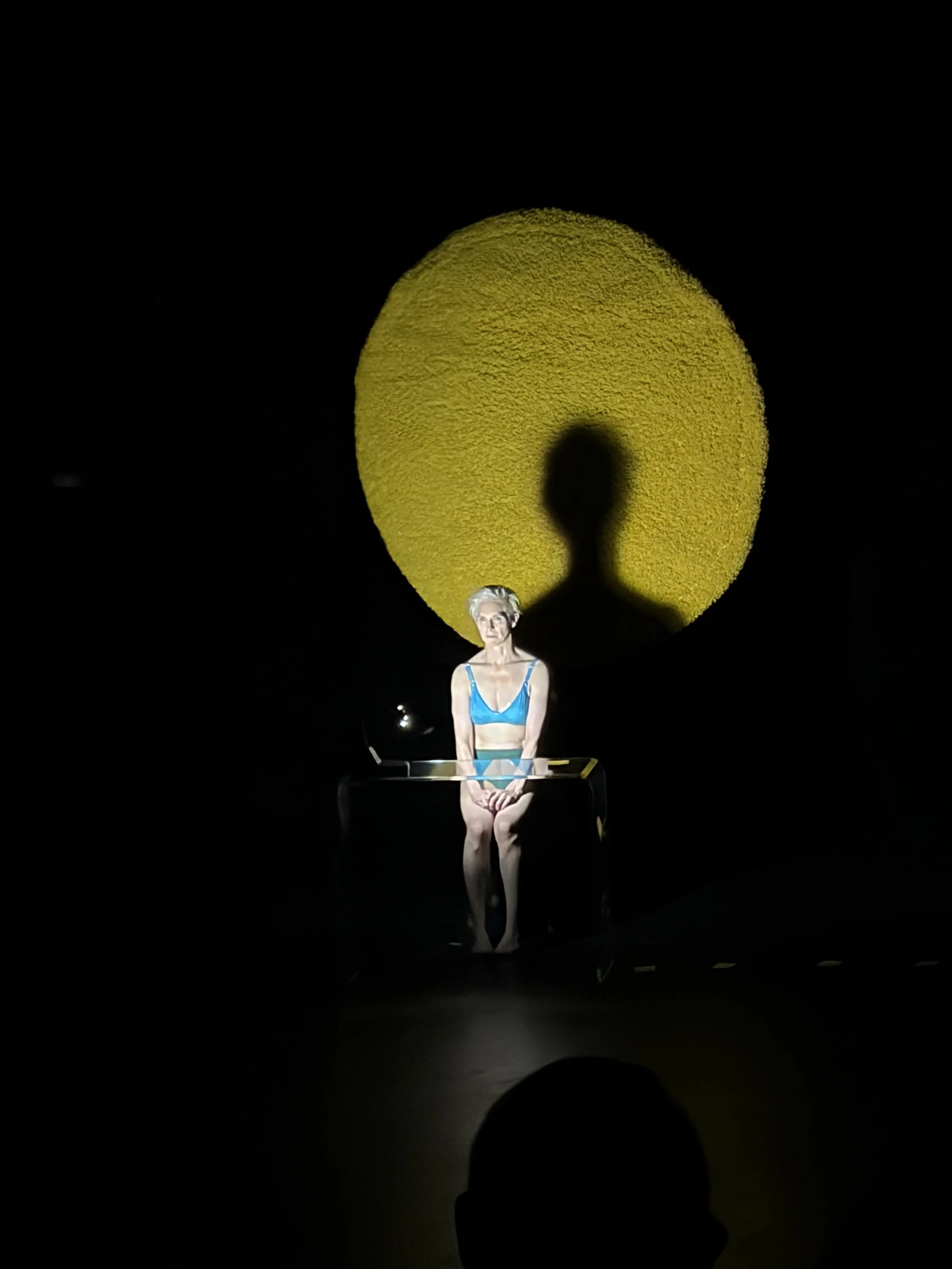
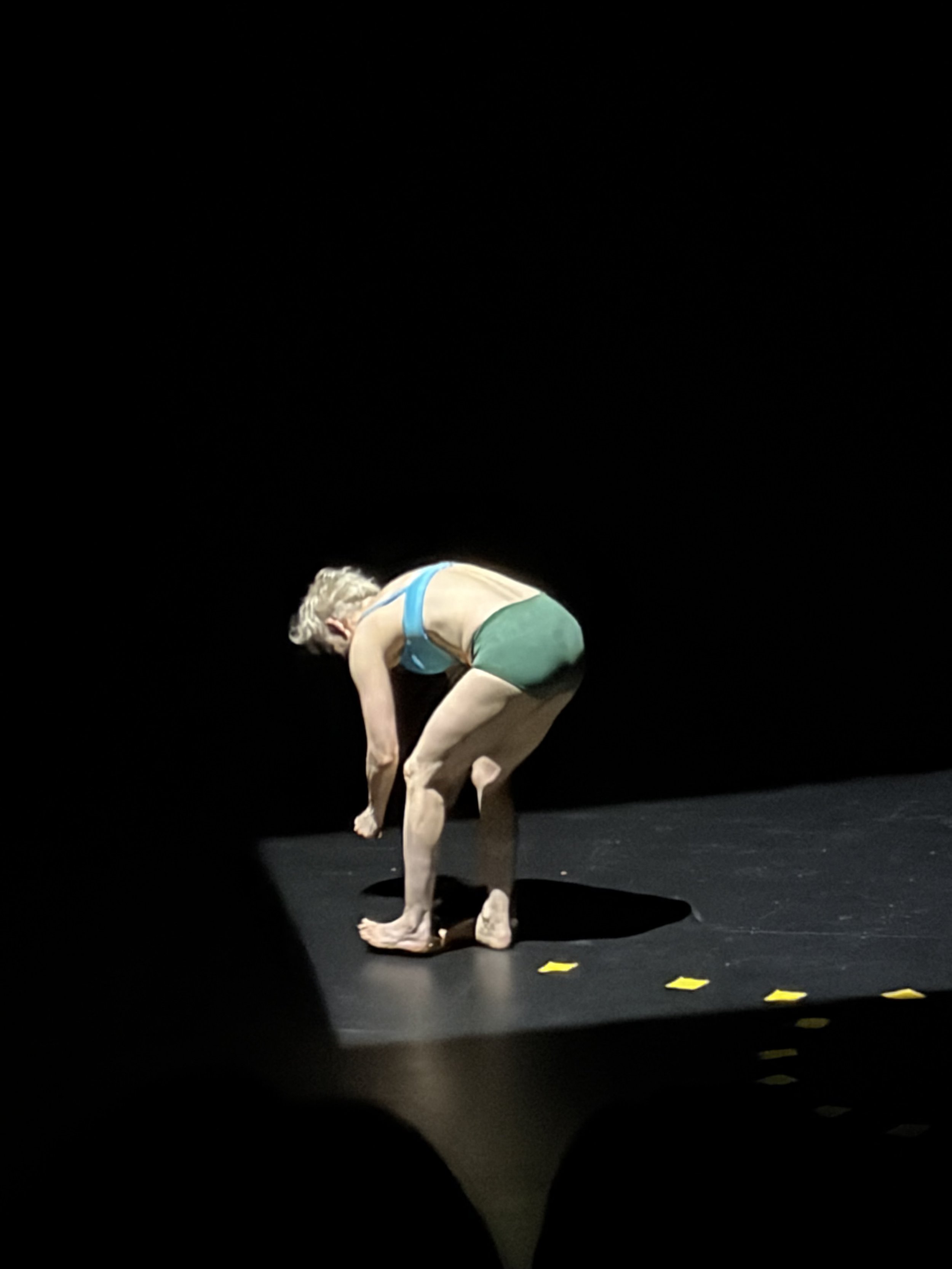
As a newbie in the world of theatre and performance arts, I thought dancing, singing, and storytelling on stage meant spectacle. Instead, part of what makes Porter’s physical and emotional presence on stage so raw is the use of minimal and oftentimes everyday props that take on an absurdist life of their own.
Hello Sunshine! is a part of the 2026 SummerWorks Performance Festival. This year’s programming gathers 27 bold and intimate performances, as well several workshops, Q&As, and panel discussions with creatives from here at home and all over the world. Porter’s performance compliments this year’s festival theme of “Fights/Flight”, where performers and artists use their work to engage with questions of body, memory, transformation, and identity.
In conversation with Porter, I was interested in getting more insight into the creative thought process and emotional journey of translating a whole lifetime of experience into a 65 minute performance; of what it takes to reach deep within and externalize the lived realities of PLME in a way that resists one dimensional ideas of disability, performance, and ultimately, the art of creating one’s own freedom and meaning against the backdrop of life’s unceasing absurdity.
MA: Several of your other performances have been “one-woman” shows, using multidisciplinary elements to contextualize and explore your personal experiences. What makes you gravitate towards the mechanisms of memoir for your craft?
SP: I’ve always been performing and making shows. But in a long career, different things take precedence at different times. So, during 10 years at home with kids [and doing various other projects], I wrote a biography, Peter in Process: Peter Bonham’s Sixty Years in Dance, of another choreographer, Peter Bonham, who was very influential across Canada. When I finished that book, the editor of the book said that I should turn my focus towards myself and write about my own life. I said to myself: that’s not what I do. I do other things. But it sat with me and I started writing little stories … short stories about my childhood, usually the most difficult parts of it.
During these years, Porter was granted access to a studio space, which gave her the opportunity to start thinking about how these stories, poems, and streams of consciousness and reflection could be translated into the language of movement and performance.
SP: I took my stories into the studio space and just started reciting them, memorizing them, and moving—and then a show was built out of that: Sara does a Solo. It was about a creative process of coming back into performing after having been out of performance for 10 years. At the time, I was very inspired by some memoirs I was reading; a couple of English writers … Rachel Cusk and Jeanette Winterson were very influential in my thinking about how to tell my own story.
SP: There was just something soloist about my character and how I perform. So, that first-person voice sits with a memoir very comfortably.
MA: When a friend first brought up the idea of creating a performance about your experiences with PMLE, you initially thought it was a bad idea. What changed your mind?
SP: People are asking me that a lot! Well, it was just responding to life. I didn’t need to talk about it. I didn’t need to bring it up. For most of my life, I could work around PMLE and didn’t have to tell people, but it got to a point where that actually was no longer possible. If I was leaving my house, I had to explain to people why I was moving the way I was or dressed the way I was. The logistics of my life are the way they are, but I didn’t love talking about it. The reason for not telling people wasn’t an intentional hiding. It was just avoiding having to deal with other people's reactions to it.
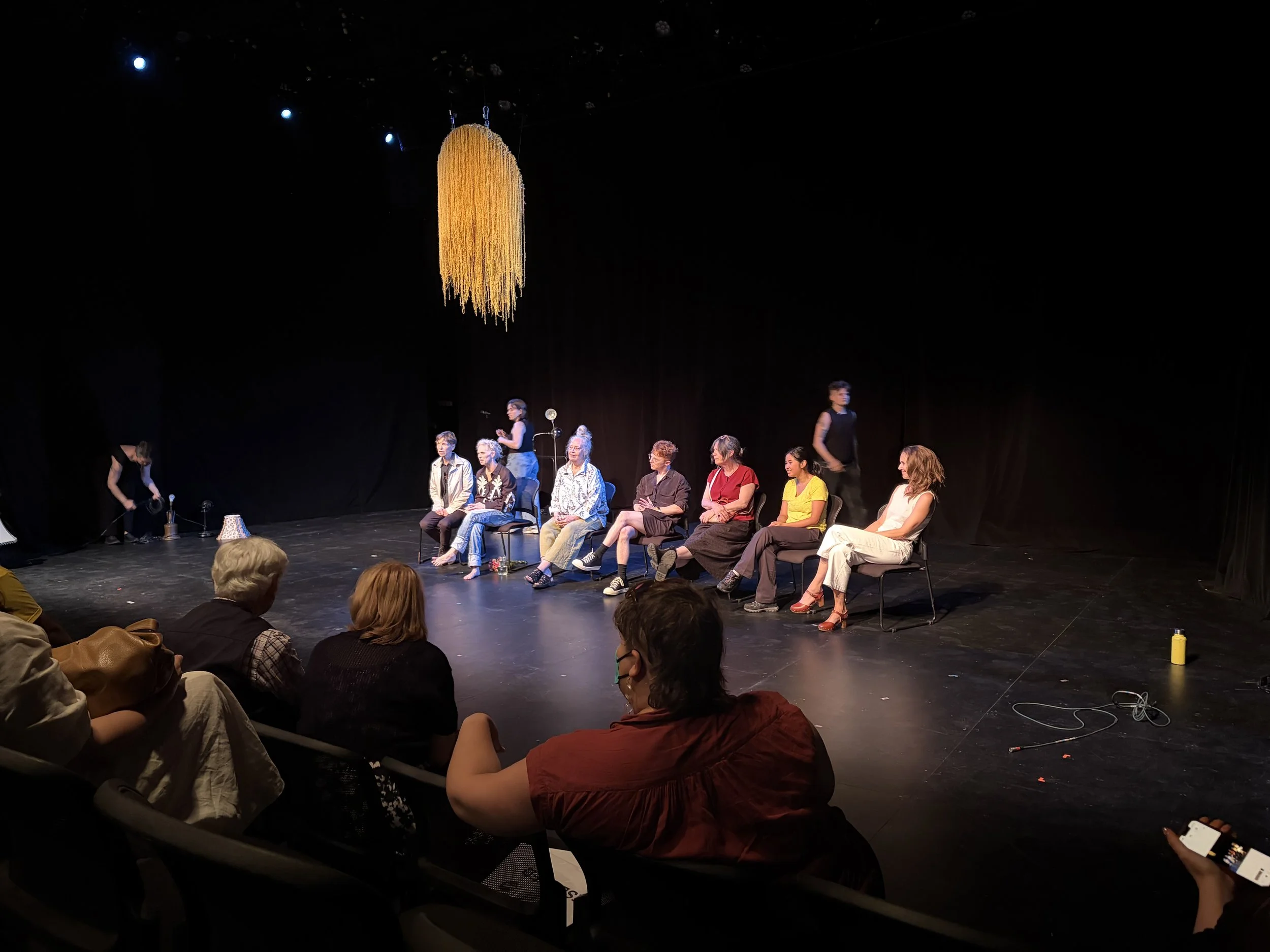
Porter’s performance was followed by a short Q&A with members of her team. Porter—the second person from the left—sits besides her longtime collaborator and creative consultant for Hello Sunshine!, Katherine Duncanson. On Porter’s right sits Alex Bulmer, a disability dramaturg.. Second from the right sits assistant stage manager and Toronto-based movement collaborator Kathy Le. For a full list of everyone involved, visit saraporter.ca/hellosunshine
Six or seven years ago, Porter acquired a disability sticker on her car so she could park closer to the doorways of buildings, which fundamentally reframed Porter’s relationship to her PMLE because for the first time, her invisible disability was made "visible" in a very tangible way.
When the conversation of her condition became inevitable, Porter found herself thinking that instead of always explaining her PMLE and subsequently having to manage other people's reactions to it, it would be better to simply direct people to a performance about her condition; a performance which captures her experience better than words sometimes can. Once this thought process germinated, Porter and her creative team took three years to bring Hello Sunshine! to life. But this performance wasn’t only about Porter.
SP: I don’t like to talk about making my work as a kind of therapeutic process because it’s far and above and beyond that. It’s not just about me. It’s really about making something outside of myself to engage the world.
MA: What did you learn about yourself through the process of making Hello Sunshine!? Did your relationship with your “sun thing” change in any way as a result?
SP: There is always an aspect of learning about your subject matter, whatever art you’re making. You always learn about your subject matter. With Hello Sunshine! the subject matter is my own discomfort with notions of calling myself disabled, and I’ve learned a lot about that through the process of making the work and also having the opportunity to learn about other people’s disabilities, of how to talk about disability and navigate terminology and the various perspectives that are at play … there’s a range of ways of discussing life’s particularities. I learned a lot about other people’s disabilities and found my own way of dealing with mine.
Later in our conversation, Porter adds that creating and performing Hello Sunshine! made her feel more at ease in communicating her needs and emotions surrounding her condition without feeling ashamed or being over-burdened by the duty of overexplanation—a form of emotional labour that many living with disabilities, invisible or otherwise, are simply expected to perform. Porter calls Hello Sunshine! her “project of explanation.”
MA: As an artist, how do you decide what parts of your experience with PMLE to include, leave out, dramatize, or exaggerate?
SP: I did try as much as possible to be very true to my subject. There have been other shows where I take greater flexibility with the narrative, but I tried as much as I could to clearly reflect what life has been like. But I certainly do dramatize things, like wearing a yellow hazmat suit and putting a bikini on top of it to the beach. That’s certainly not something I do in my life, though I do wear a bathing suit that does go down to my wrists and my fingertips and over my head and down to my ankles.
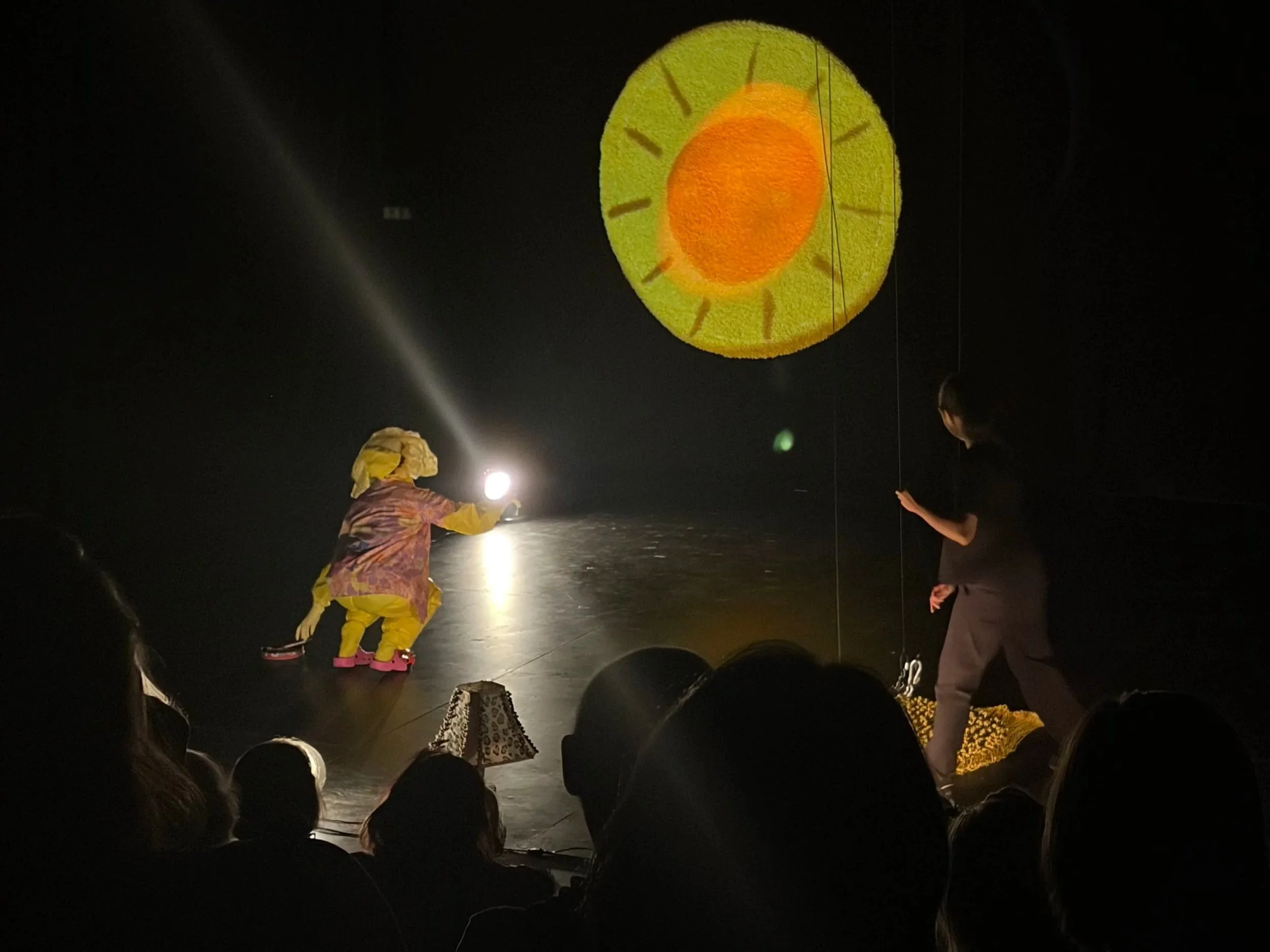
In one scene, Porter, with the help of her assistant stage manager Kathy, dramatizes a day at the beach: a bikini slithered on top of her hazmat suit. Of course, this is not how she normally dresses—even though she still has to cover up most of her body—but sometimes the best way to communicate and process the absurdity of life is to laugh at it.
When I asked her about the editing process, Porter spoke about employing her intuition of what scenes to keep and what scenes to cut, and also the privilege of having a creative team that one can critically and honestly build something beautiful with.
SP: My collaborators are of course outside of the show looking in, and helping order scenes. But there is also an element of construction or a process of construction that is driven by me, inside the work, in the studio, on the stage.
The emotional and creative center of Hello Sunshine! is Porter engaging with the contradictions and discomforts of PMLE. Porter manages to visibilize her invisible disability through a subtle yet powerful social commentary about the politics of disability in a way that doesn’t feel contrived or overly cerebral.
A part of what made the performance so enticing and refreshing for me as a first-time viewer of theatre was that the impact of any form of social or political suggestion seemed to emerge from the in-between moments; moments of silence between songs or dances where the audience are forced to sit and absorb.
In one particularly poignant scene, Porter explores the realities of going to the doctor to search for answers about her condition. In the scene, Porter tries to explain the peculiarities and struggles of her PMLE, hoping for some sense of direction, but is repeatedly interrupted and overridden by the doctor—“played” by Porter in a slightly different demeanor—putting words in Porter’s mouth. In another scene, Porter sings of the many questions and statements she’s received about her condition, the most frustratingly funny of which was: have you tried putting on sunscreen?
MA: When did you start learning more about disability? And how did that new world change how you understand yourself and your work?
SP: Only in the last couple of years have I considered the terminology of disability for myself, even though I’ve been living with PMLE for 40 years. For the longest time, it was just my “sun thing,” so it didn’t have any kind of pathology around it. Around three to four years ago I started reading some disability studies—texts and research articles—and found myself really drawn into that intellectual world about how people are navigating the language. It’s always such an interesting thing to learn about yourself through other people, through strangers. We think that we have this intimate knowledge about our intimate lives, but in fact, we can learn more about our intimate selves from complete strangers.
This sentiment goes back to Porter’s affinity towards memoirs and the art of self-narrative—of why it’s such a core creative structure in the backdrop of most of her work.
SP: The intimacy question is really interesting to me because I’m really curious about what other people live with. How do others deal with difficulty? How do we tell the stories about what our lives are like? 100 years ago, we did not freely talk about clitorises or female orgasms, right? So, generations have different ideas of what we’re allowed and not allowed to talk about, and how.
Porter is fascinated by how these boundaries are navigated and continuously renegotiated; how the tensions and contradictions of the human and bodily condition—especially under social rules that dictate how we are viewed by a world shaped by ableism and oppression—can be made legible through art.
Importantly, the impact of Hello Sunshine! comes from the sentiment that the stories we choose to tell about the often private and silenced corners of our lives, change us irrevocably. They change the world, too. Art, and specifically, movement-based multidisciplinary storytelling, allows us to have ownership over our stories and how we choose to experience our bodies. And that is inherently political.
MA: There can be a lot of pressure, especially in mainstream media, to portray disability and disabled bodies and stories through the binary of either tragedy or triumph. How does your work make room for something more complicated or ordinary?
SP: As a dancer, I watch other peoples’ bodies. I see how other people live in my teaching. I like to think that, even though I teach people how to dance, I also teach them how to experience their own bodies in new ways. It manifests in movement—through dancing—but mostly I help people experience their bodies in ways that are pleasurable. And I know that sounds sexual, but I do talk about the sensuality of your own body while you are dancing.
Porter’s next goal with Hello Sunshine! is to ensure the show’s greater accessibility and longevity. It’s important for Porter to extend her show’s lifespan so that more people can, through her, like she has done through others, learn to experience their body, identity, and artistic spirits anew.