
Who are my people? Where are my people?
A conversation about South Asian diasporic art with the creative team of Belly Button
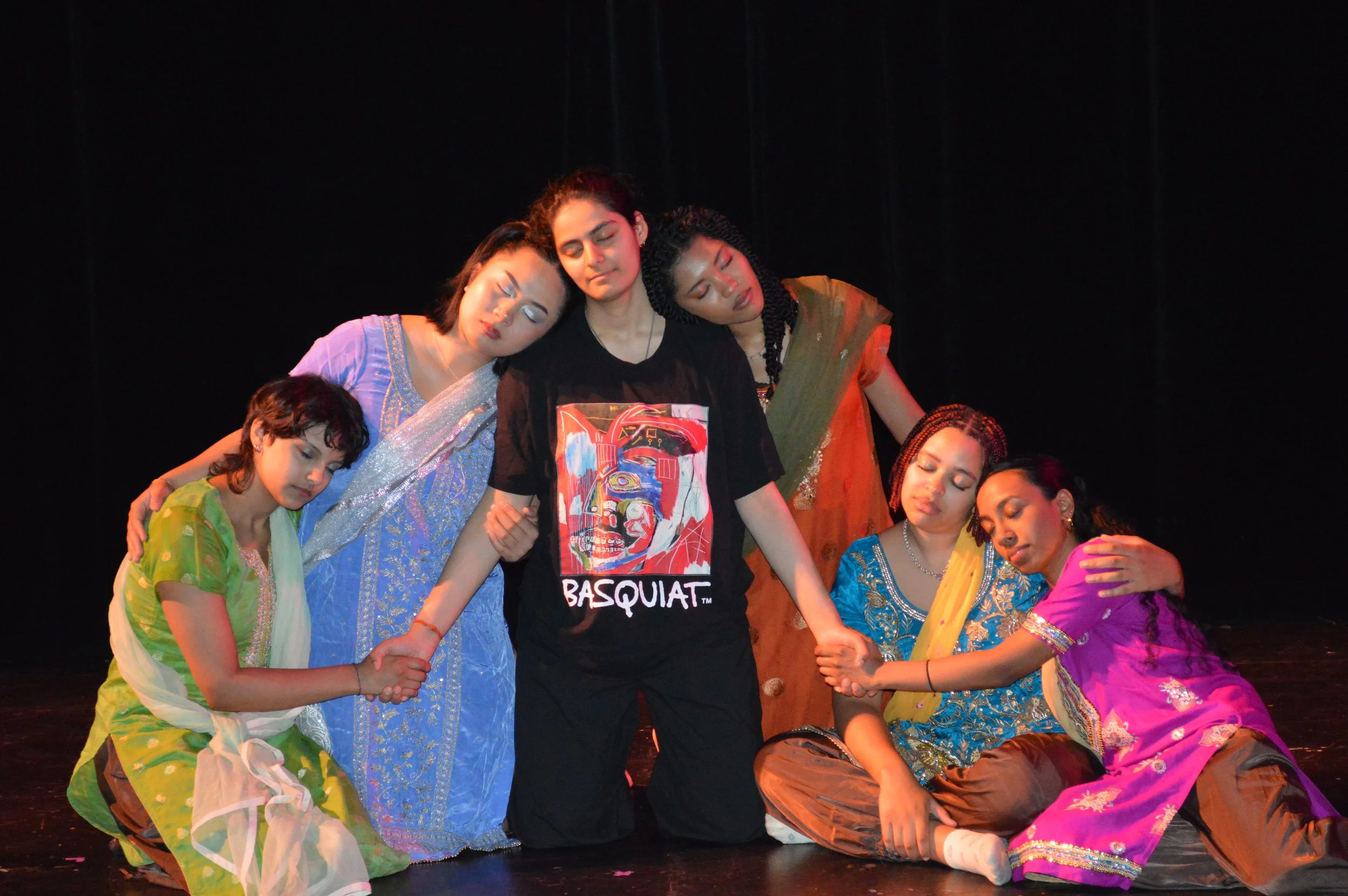
Alexandra Martin, Reena Goze, Trinity Lloyd, Stephanie Bisram, Nora Alexander, and Shriyanshi Quanoongo connect onstage.
What does it mean to be South Asian? What does it mean to be Queer? What does it mean to be South Asian and Queer? These are the answers I find myself searching for whenever I think about who I want to be. I always end up in the same place, searching for media containing an inch of a Brown person’s presence, and searching even further for a pixel of South Asian, Queer imagery.
In my search for plays by South Asian artists at the 2026 Toronto Fringe Festival, I found one that felt warm: Belly Button. This is a story about Q, who crawls through their own belly button and they meet Amrita Sher-Gil, a painter who challenges Q’s views about their own heritage and family.
During the production, I felt so much. It was weird, it was angry, it was funny. It was colourful, moving, and pretentious. It felt so familiar and unique to myself, and yet, the seats were filled with people who felt the same. The crowd was laughing, gasping, sighing, in sync like the chorus on stage.
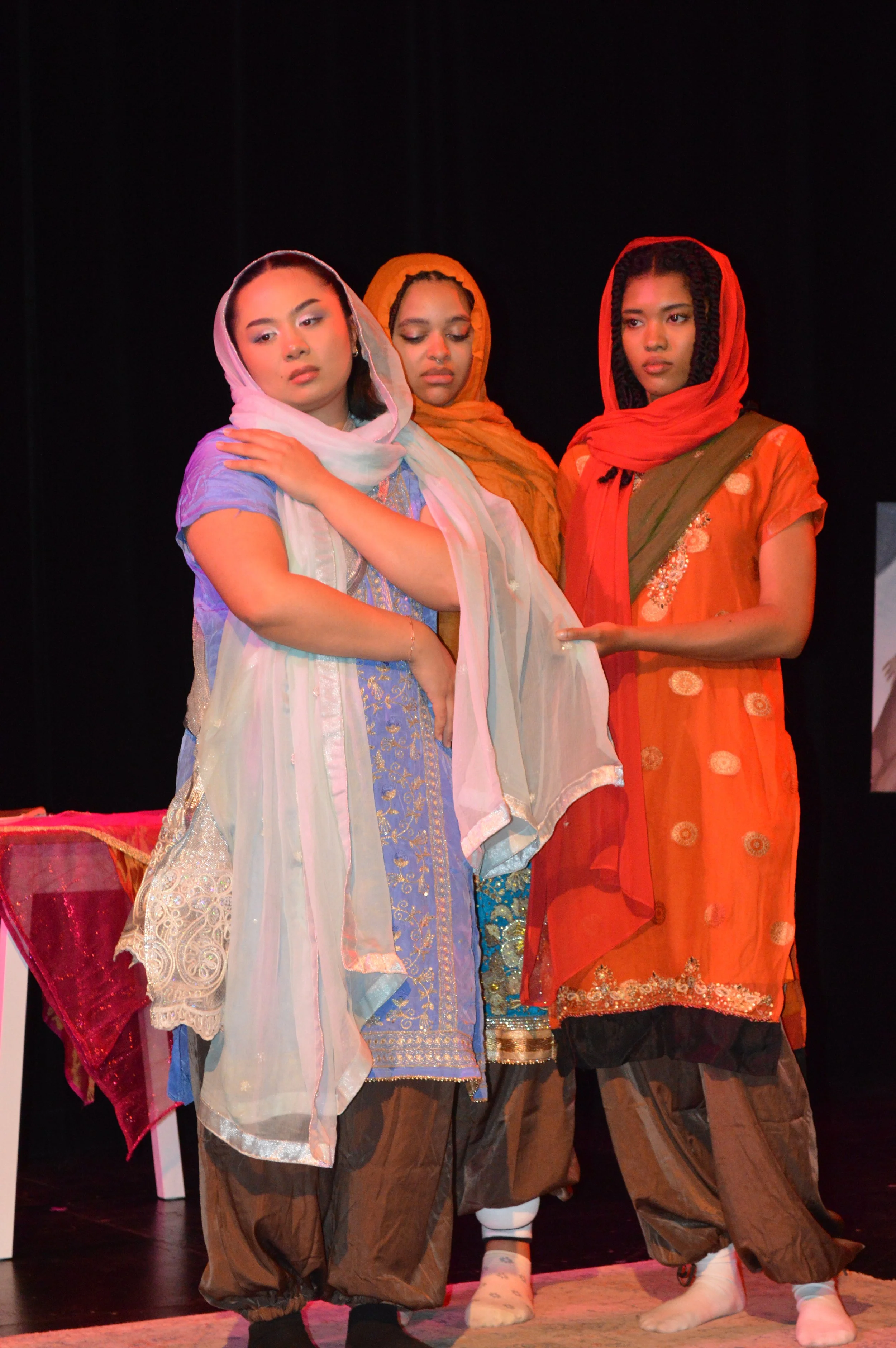
(left) Alexandra Martin, Reena Goze, Trinity Lloyd replicate Amrita Sher-Gil’s painting ‘Three Girls’ (1935).
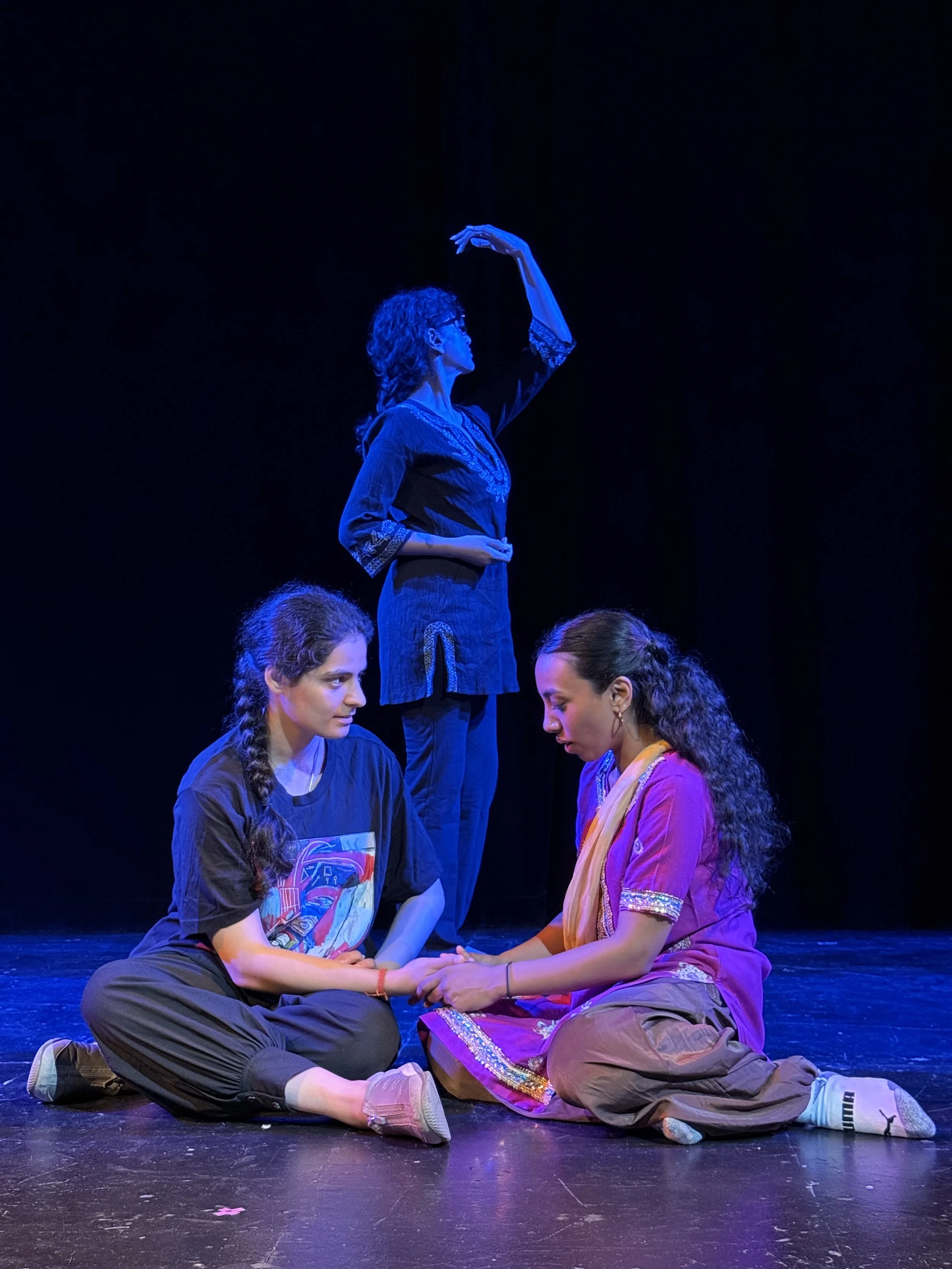
(middle) Sandy Aurora Ramdin, Stephanie Bisram, and Shriyanshi Quanoongo share an intense moment.
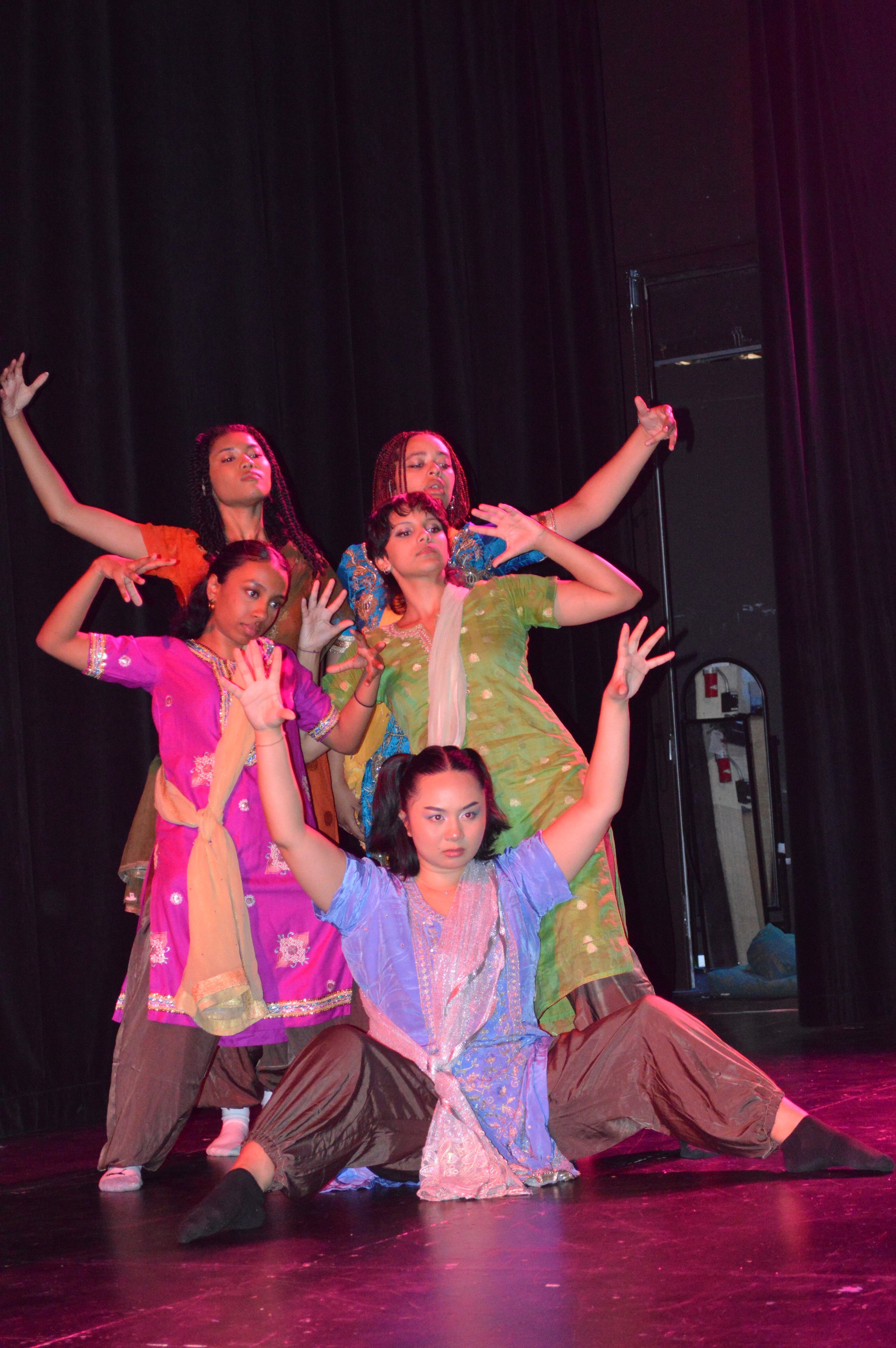
(right) Alexandra Martin, Reena Goze, Trinity Lloyd, Stephanie Bisram, and Nora Alexander shine as chorus members in their movement.
I had never felt such a strong sense of community just from sitting in the house. I had the urge to find more of it.
I spoke with the creative team of Belly Button: Hemali Sankalya Ratnaweera, the playwright; Shaharah "Gaz" Gaznabbi, the director; and Nuha Yousuf, the movement director. In that conversation, I understood what it meant when people say be the change you want to see.
The script for Belly Button stemmed from writing a monologue, where Hemali got a spark of imagery: someone crawling through their belly button. An image like that, it’s hard to shake, but easy to toss aside when it comes to developing something concrete. Hemali didn’t stop there.
H: “I used to not trust the way I wanted to do things. So I made that voice, or that impulse, really small in me. I went on this path (where) I would work in rooms I didn’t feel good in...then when I started directing/producing and now, writing and collaborating in those ways, in the way that I wanted to do, the more I defied that voice, […] the more I felt fulfilled, heard, and good with the people I was around and working with.”
She had written so much before, but this was the first time she felt like her writing sounded like her voice. As scenes developed, Hemali’s partner introduced her to Gaz, who then found interest in the script and worked with her as a dramaturg. Gaz took interest in Q’s character and their struggling relationship with their mother.
G: “It was a story that Hemali was telling in a really beautiful way, starting with this gorgeous entrance into the belly button, talking about maternity and motherhood. I liked that it was this character that could be non-binary, and could be South-Asian diasporic, but the story wasn’t necessarily about that. It was about their connection with their mother…and looking towards something that scared them.”
This connection to the script eventually inspired Gaz to introduce Nuha to Hemali, with the intention of taking her on as the movement director. As Gaz and Hemali explained to me how Nuha joined the project, I could feel the connection between the three of them, and it started to make more sense how the show came together so harmoniously.
G: “Nuha was a perfect addition to movement, ‘cause I knew that her background was in devised and weirdo dancing. So, (to Nuha) I knew that you’d be down and down to do it in a collaborative and meaningful way.”
H: “I remember the first time we spoke, (to Nuha) you had such a creative outlook, and you had such an experimental lens in all the art you’re interested in. I liked how you carried yourself, too. I liked how you interacted with people. I just think you bring a certain energy that makes people feel good in collaborating.”
Nuha’s movement in the show brought a warmness I didn’t know I craved. There’s a moment where three members of the chorus each hold a shawl (dupatta) and dance, slowly growing a braid connected to Ammi’s (Q’s mom) hair. Something about this felt so nostalgic, and Nuha nailed it.
N: “I’m Pakistani, and some of my earliest memories of being cared for…was my mom oiling my hair with coconut oil, giving my head a massage, and braiding it. You (to Gaz) talked about diaspora and how it can be not specific, it can still apply to any South Asian diaspora, and I think braiding still applies to any South Asian diaspora.”
Her braiding imagery shines throughout the show but especially in a section titled Movement of My People, as a way to find connection between the South Asian diaspora. The imagery of the umbilical cord, hills, valleys, they all form a landscape of us trying to find our community. Belly Button is a success story in finding that community.
N: “Day 1 was our community night, where you’re seeing a lot of Queer South Asians, and that made me really happy–and then I liked seeing today, where it wasn’t even marketed as a community night, but it was still full of Queer South Asians, and South Asian people, and that made me feel really proud.”
Belly Button doesn’t claim to speak for the Queer, South-Asian experience, but speaks for Q’s experience, and it is a love letter from Queer, South-Asian artists who can relate to the experiences that come with being who they are.
H: “I’ve realized how important it is to know each other, and find each other, and be able to do that. There (are) people making that happen, people that I’ve met. We’re not alone. There (are) a lot of people who’ve had similar experiences even though they’re not exactly the same.”
G: “There’s not one way to be South Asian, there’s not one way to be Queer, and there’s not one way to be South Asian and Queer, either. That is a diaspora in itself.”
N: “It’s okay if your Queer journey looks different than someone else’s. Your journey is your journey whatever it may be.”
Gaz has said before that we need more unapologetic work in Toronto, and as South Asian, Queer artists who have been told we must be submissive in order to succeed, that can be tough. But speaking with Hemali, Gaz, and Nuha, I recognized that a project like Belly Button only comes with the effort to break the rules handed to us, as descendants of the diaspora. I asked them each for words of encouragement for myself, but they’re for you as well.
H: “If you have any idea, it is not dumb. It is an impulse that is coming from within you that you should follow, because you have the power to make change, just like any one of us. So don’t make that impulse small, because that voice is telling you something. Telling you that something can be different.”
G: “Feel free to defy your mother… A show like this would scare her, because it’s Brown, and it’s Queer, and there’s a naked lady, and it’s free, there’s a lot of sexual liberty weaved into it as well, I think that’s something that would terrify her… Being able to defy my mother … has allowed me to let go of the intergenerational anxiety, and do unapologetic work in that way.”
N: “The best way to do it when you don’t have institutional support … is to create your own work and employ yourself, and employ your community, and lean on your community, and create work for your community.”
Taking Nuha’s advice, I would like to do my part in supporting my community. I encourage you all to go see Belly Button at the Toronto Fringe Festival from now until July 11th.
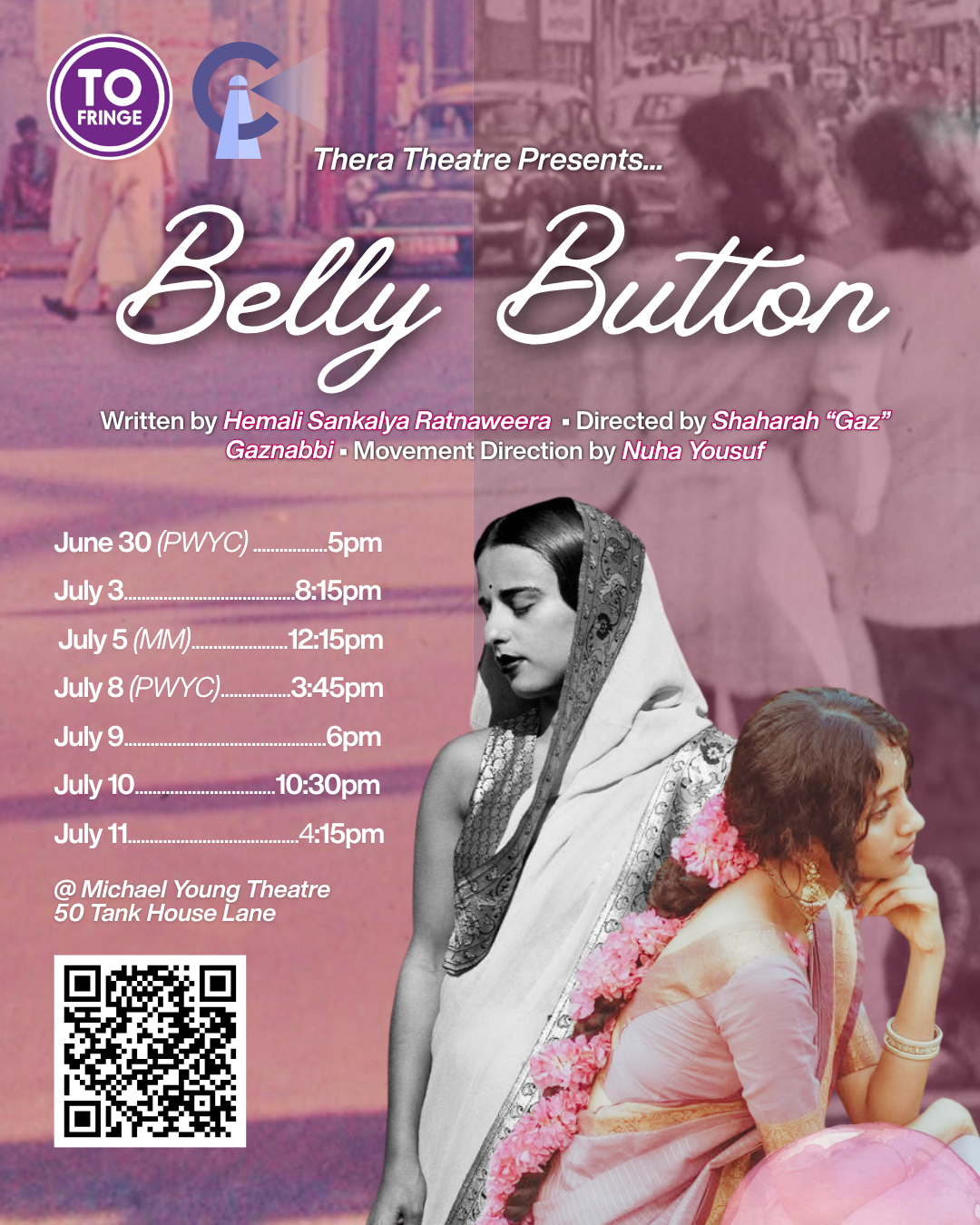
With that, I also extend my request to include supporting art made by communities you would like to see yourself be a part of and would like to see more of.
Marketing Designs by Mercedes Isaza Clunie; Photos by Mercedes Isaza Clunie; Costume Design by Crescent Choudhary; Lighting Design by Sephora N'Kosi; Set & Prop Design by Sebastian Cattrysse. Developed and produced by Thera Theatre @theratheatre.